

What is bias is very debatable yet critical to the discussion?
What is bias all about- is probably the most common question in the Theory of Knowledge. As and how you explore ‘how you know what you know’ in Theory of Knowledge, you will come across many problems of knowledge. Bias is one of the problems of knowledge. Before we dig in deep to find out the reasons for bias, let us understand when can a piece of information be treated as knowledge.
Theory of knowledge-
Is all information knowledge?
Gathering information is easy because there are so many facts and figures scattered around us. Constructing knowledge from the available information is challenging, for the fact that collecting random information is cumbersome. There is so much data perceived by our senses, that our brain finds it difficult to process it all.
Now, the question is how much and what information will our brain process? Also, the construction of knowledge takes into granted the knowledge we already have and which has formed our belief. ‘What is knowledge’?-can remain unanswered due to human limitations in cognitive approach, imagination, comprehension, and many other things.
The crux is that the limited data which each of our brains processes, probably, depends partially on the discretionary power of the brain. The discretion of the individual brain is that it would register that information what it wants to register, and what connects with its previous belief. Some of the information may be impromptu and randomly picked up by the brain. Hence, the question here is on what basis a piece of information becomes knowledge?
Evidence to validate information
To construct knowledge either from the information or from prior knowledge requires validation of information through empirical evidence. However, the question is what qualifies as evidence to validate knowledge?
Empirical evidence is presumed to be universally objective because they are obtained through observation and documentation. Empirical evidence backs up the scientific investigations. Thus, it is quite logical to presume that empirical evidence qualifies as cogent evidence for validating knowledge.
Are sciences universally true?
If we presume empirical evidence to be completely objective, then there is no possibility of errors or problems in the scientific results of natural sciences. What I mean is natural sciences should be completely objective and universally true. But in reality, is it the case? Not really.
Scientific results are inflicted by challenges of lack of objectivity. One such challenge is the natural reproducibility crisis.
Often scientific results cannot be replicated because scientists use a methodology that is a contextual framework. What do I mean by a contextual framework? It means that in order to get logical and coherent results, researchers often bank on their beliefs, values, and perspectives.
See how the unconscious skewness in perspectives and beliefs can impact the scientific outcomes even in medical sciences. ‘The survey of 85 Black veterans showed that most had good patient-provider relationships, but many expressed some issues that indicated race could play a role in their healthcare’ (source)
Why are our beliefs and perspectives skewed?
Now that I am talking about unconscious skewness in beliefs and perspectives of scientific researchers, why do you think that there can be some elements of unknowing or implicit or inherent skewed perspectives and beliefs? This is because there is a variety of diverse experiences we encounter. We pick up the information from our experiences and claim it as knowledge.
Why my knowledge on the same thing is different than yours?
Each of us would pick up the information as ‘knowledge’ differently and unique to our experiences. Our brain would process the knowledge constructed using unique filters or shortcuts. What is ‘knowledge’ for each of us is, to some extent, unique and optimum information processed by our brain. What authenticates information to be knowledge for each of us, is evidence. The evidence is proclaimed concepts to substantiate and prove the information we have gathered as knowledge.
Are evidences skewed?
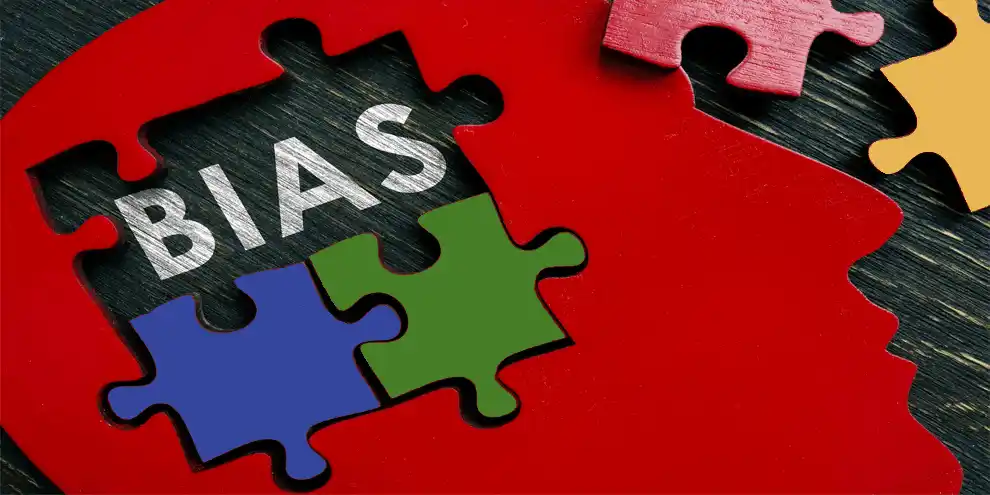
Since evidence is used to claim information as individual knowledge, the mind-boggling question is- ‘are evidence skewed’? No wonders what our brain selects, gathers, processes, and remembers is in confirmation with our assumptions and preconceptions. Some evidence is based on our beliefs, prior knowledge, and assumptions which are partially skewed, so the evidence is also inflicted by implicit skewness. It is well understood that in spite of processing information with so many filters, the knowledge we construct is not free of these implicit factors or assumptions which skew our perspectives. So, knowledge comes with BIAS.
What is bias?
No wonders media is a great influencer in creating biases like cherry-picking, deep fakes. The mass impact of media may make you gullible to biases like propaganda, echo chambers, and circular reporting. We believe and claim to know ‘what we want to believe’
There would be some information that conforms to and confirms our beliefs, perspectives, assumptions, and preconceptions. We love to accept that information and harp on them. We base our knowledge on what we want to know, and the knowledge becomes our bias. On the other hand, there is some information that contradicts our beliefs, perspectives, assumptions, and preconceptions. We hate to accept them or straight away reject them, irrespective of whether they are right or wrong.
Right or wrong information
Now, who would judge right or wrong? In fact, if we are claimed to have bias, we try to prove the information and validate it with logical reasons. Though reason shows up as a validation parameter, the reason forming the evidence to validate our bias is also searched to belong on our side of the table.
What do you feel about Kathleen Hartnett White as the head of the EPA? Was she biased as a lobbyist of an advocacy group funded in large part by the energy industry?
Let’s see another example of unconscious bias. Our common expectation is that men are leaders, providers, assertive, strong personalities taking charge; while women are supportive, emotional, helpful, sensitive, fragile, and personalities taking care. These are the expected patterns to which we have been exposed throughout our lives. So, our brain unconsciously redirects us towards these patterns it recognizes. We create pattern stereotypes, which are buried deep in the subconscious minds.
As you explore more and more about knowledge and reflect on what you know, you will understand that bias is indispensable and inevitable in the pursuit of knowledge.
Check out another page – What is a perspective?

